Abstract
Zero-shot object-goal navigation requires autonomous agents to explore un seen environments and locate target objects without task-specific training, posing challenges in perceptual reliability under observation uncertainty and physically grounded goal termination. Although foundation-model-based ap proaches improve generalization, they remain vulnerable to unreliable long range perception, hallucination-induced directional bias, and semantically plausible but geometrically incorrect stopping decisions. To address these limitations, we propose CSG-Nav, a lightweight zero-shot navigation frame work centered on confidence-aware multimodal information fusion. CSG-Nav introduces three complementary fusion mechanisms. First, multi-source se mantic fusion integrates open-vocabulary detection results, detection con fidence, scene observations, and relational reasoning to cross-validate se mantic evidence and suppress hallucination-induced directional bias. Sec ond, spatial-confidence fusion weights multi-view semantic evidence using a Gaussian decay function, suppressing unreliable distant observations while accumulating spatially consistent exploration preferences. Third, semantic geometric dual verification fuses semantic target detection with depth-based 3D localization to support physically grounded stopping decisions. Experi ments on HM3Dv1, HM3Dv2, and MP3D demonstrate competitive zero-shot performance, achieving success rates of 58.9%, 71.6%, and 44.3%, respec tively, with a compact 4B model configuration. Fusion-level ablations and real-world deployments in indoor and outdoor environments further verify the effectiveness and practicality of CSG-Nav for robust navigation under uncer tain perception.
Method Overview
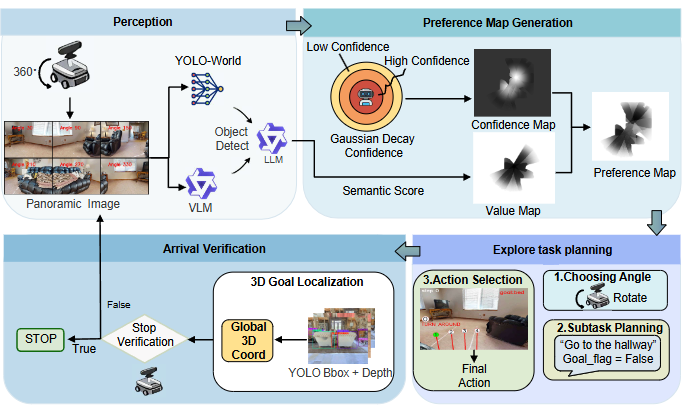
An overview of our method. The agent first surveys its current location and selects observations from 6 angles, stitching them together to form a panoramic image. Then, the agent evaluates each angle and chooses the one with the highest preference score for subsequent exploration. If the target is detected during the exploration process, the verification module is activated to verify precise arrival at the target.